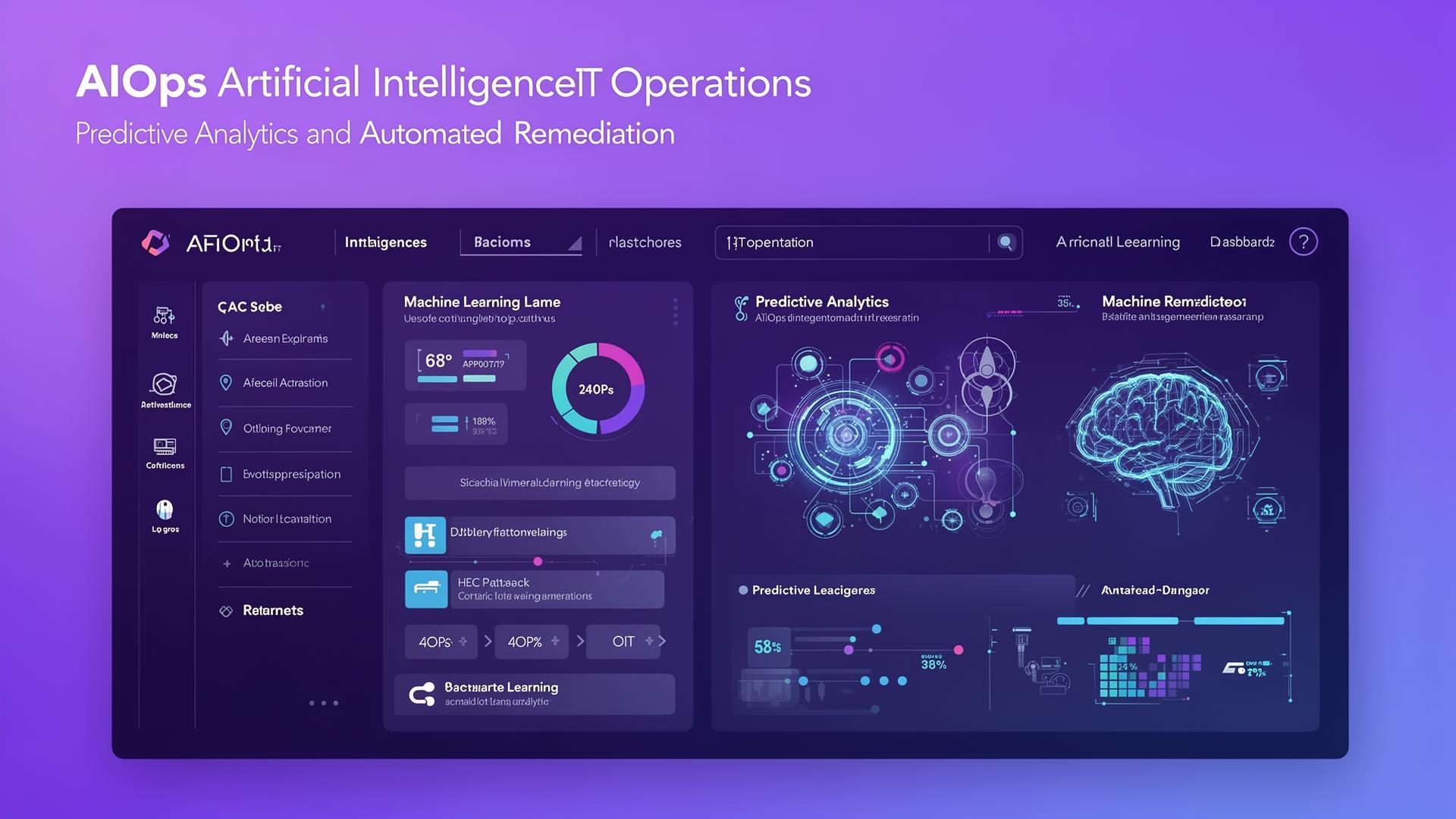
# AIOps in Practice: How Artificial Intelligence Is Transforming IT Operations
Modern systems generate torrents of data. Log volumes measured in terabytes. Millions of metrics per minute. Alerts from dozens of monitoring tools. Human operators cannot possibly process it all manually.
AIOps, which stands for Artificial Intelligence for IT Operations, applies machine learning to this challenge. Anomalies surface automatically. Correlations appear without manual investigation. Predictions warn of problems before they cause outages.
## Understanding the AIOps Approach
Traditional monitoring works on predefined rules. If CPU exceeds 80 percent, alert. These static thresholds generate noise during normal variations and miss problems that manifest differently.
AIOps learns what normal looks like for your specific environment. It understands that CPU runs higher on Mondays. It recognises seasonal patterns.
This learning enables **dynamic baselines**. Alerts trigger when behaviour deviates from established patterns, not when arbitrary thresholds are crossed.
## Key Capabilities
**Anomaly detection** forms the foundation. Machine learning algorithms continuously analyse metric streams, identifying deviations from expected behaviour.
**Noise reduction** transforms alert volumes. Instead of receiving hundreds of individual alerts during an incident, operations teams see consolidated events.
**Root cause analysis** accelerates troubleshooting. By understanding system dependencies and correlating events temporally, AIOps suggests probable causes.
**Predictive analytics** anticipates problems. Machine learning identifies patterns that precede failures. Early warning enables proactive intervention.
**Automated remediation** closes the loop. When known issues occur, predefined responses execute automatically.
## Implementation Considerations
AIOps is not magic. Successful implementations require quality data, reasonable expectations, and ongoing tuning.
**Data quality** matters enormously. Machine learning amplifies whatever patterns exist in your data.
**Training periods** set baselines. AIOps systems need time to learn normal behaviour.
**Tuning never ends.** Business changes, infrastructure evolves, and patterns shift.
If your organisation struggles with operational complexity, contact us through our contact page.
## What AIOps Can and Cannot Do
AIOps is useful for:
- noise reduction (alert correlation),
- anomaly detection,
- and surfacing likely root cause candidates.
It is not magic. If your telemetry is inconsistent or your CMDB is wrong, the outputs will be wrong.
## A Safe Adoption Path
1. Start with **read-only insights**. 2. Move to **recommendations with human approval**. 3. Automate only **low-risk runbooks** (restart a service, scale a pool) with tight guardrails.
Treat automation as a change management problem as much as a tooling problem.
## What AIOps Can and Cannot Do
AIOps is useful for:
- noise reduction (alert correlation),
- anomaly detection,
- and surfacing likely root cause candidates.
It is not magic. If your telemetry is inconsistent or your CMDB is wrong, the outputs will be wrong.
## A Safe Adoption Path
1. Start with **read-only insights**. 2. Move to **recommendations with human approval**. 3. Automate only **low-risk runbooks** (restart a service, scale a pool) with tight guardrails.
Treat automation as a change management problem as much as a tooling problem.