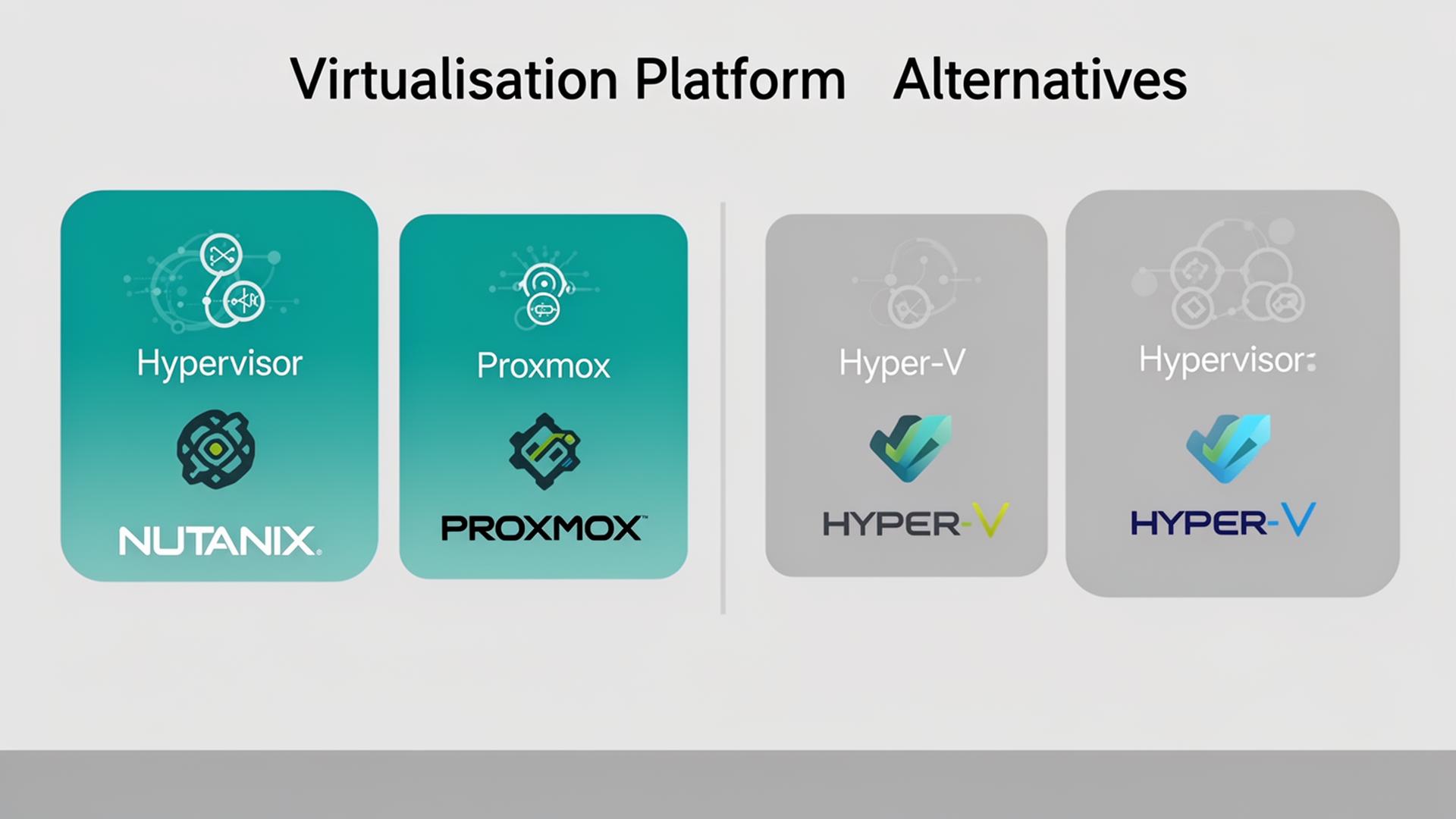
# Beyond VMware: Exploring Enterprise Virtualisation Alternatives
For many IT professionals, VMware and virtualisation are nearly synonymous. vSphere has dominated enterprise data centres for so long that imagining alternatives requires mental effort.
The Broadcom acquisition changed the calculus. Licensing restructures affected pricing for many customers. Suddenly, those VMware-dependent organisations found themselves evaluating alternatives they had ignored for years.
## Understanding Why Alternatives Matter
**Vendor lock-in risk** increases when single providers dominate critical infrastructure. VMware's capabilities created dependencies that resisted replacement.
**Pricing pressure** follows concentration. Without credible alternatives, vendors set terms.
## Microsoft Hyper-V
Hyper-V provides enterprise virtualisation included with Windows Server. No separate licensing for the hypervisor itself.
System Center Virtual Machine Manager adds management at scale. Clustering, live migration, and high availability work reliably.
For Windows-centric workloads, Hyper-V often makes perfect sense.
## Nutanix
Nutanix pioneered hyperconverged infrastructure. Their Acropolis Hypervisor (AHV) eliminated ESXi licensing fees for Nutanix customers.
The Nutanix ecosystem provides comprehensive data centre capabilities. Prism management centralises control.
## Proxmox Virtual Environment
Proxmox VE brings enterprise virtualisation capabilities to open source. Based on Debian Linux with KVM virtualisation and LXC containers.
The core platform is completely free. No per-socket licensing. No VM count limits.
Proxmox handles surprisingly sophisticated environments. High availability clustering works. Live migration moves running VMs.
## OpenStack
OpenStack provides cloud infrastructure software for building private clouds.
The platform is modular. Nova handles compute. Neutron manages networking. Cinder provides block storage.
Complexity represents OpenStack's primary challenge. Deployment requires significant expertise.
If your organisation is evaluating virtualisation alternatives, contact us through our contact page.
## What to Evaluate Beyond Features
When you move off a mature platform, feature checklists are not enough. Evaluate:
- **Operational tooling** (backup integrations, monitoring, automation)
- **Skill availability** in your team and hiring market
- **Support model** (community vs enterprise)
- **Roadmap stability** and vendor lock-in risk
## Migration: The Practical Order of Operations
1. Inventory workloads (OS, CPU/RAM, storage, networking, dependencies). 2. Identify “easy movers” (stateless apps, test/dev, non-critical services). 3. Build a migration factory: repeatable patterns, templates, and validation. 4. Move critical systems last, with a rollback plan.
Treat storage and networking as first-class migration workstreams; most surprises come from those layers.
## What to Evaluate Beyond Features
When you move off a mature platform, feature checklists are not enough. Evaluate:
- **Operational tooling** (backup integrations, monitoring, automation)
- **Skill availability** in your team and hiring market
- **Support model** (community vs enterprise)
- **Roadmap stability** and vendor lock-in risk
## Migration: The Practical Order of Operations
1. Inventory workloads (OS, CPU/RAM, storage, networking, dependencies). 2. Identify “easy movers” (stateless apps, test/dev, non-critical services). 3. Build a migration factory: repeatable patterns, templates, and validation. 4. Move critical systems last, with a rollback plan.
Treat storage and networking as first-class migration workstreams; most surprises come from those layers.