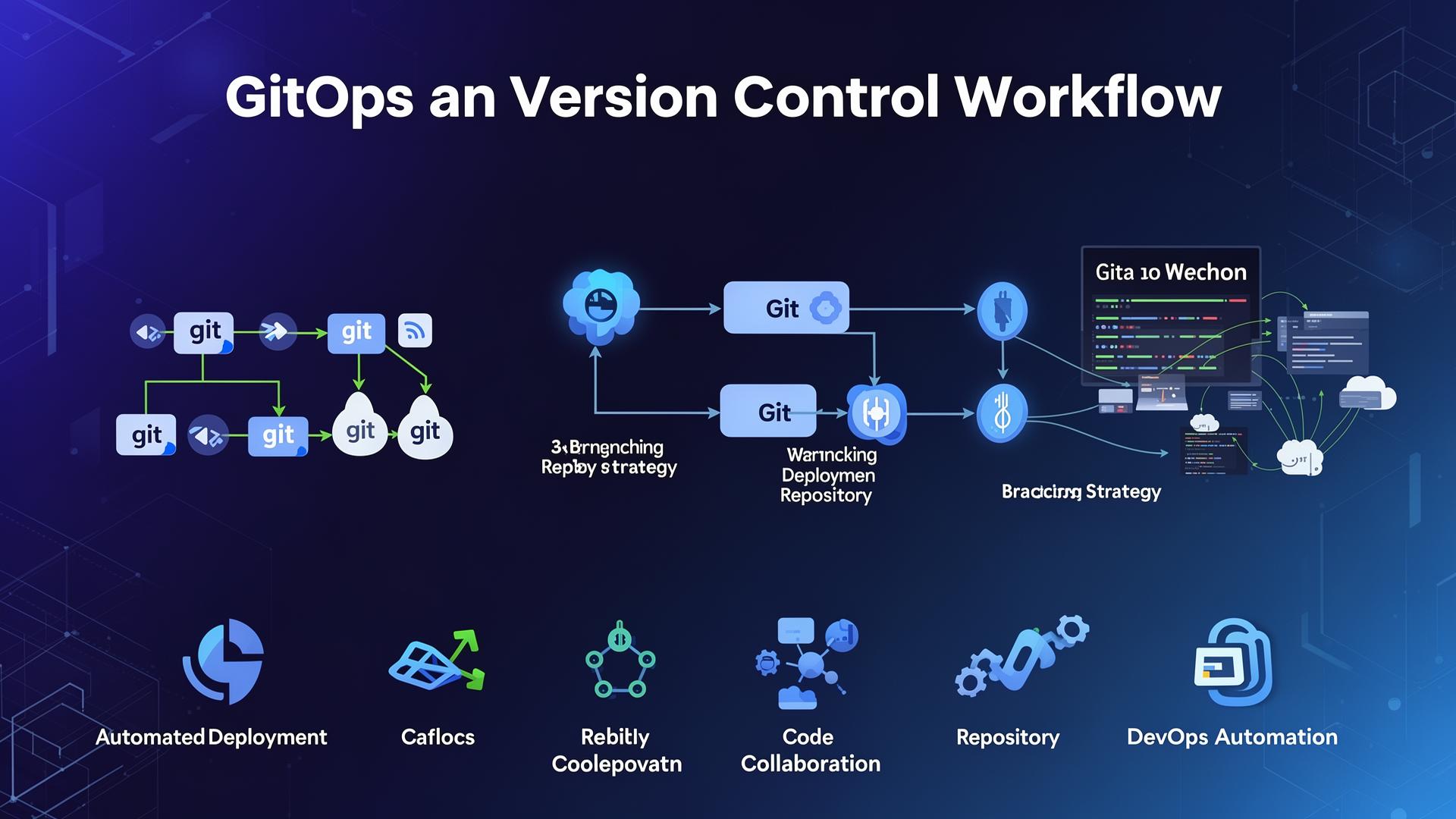
# GitOps: Declarative Infrastructure Through Git Workflows
Infrastructure as Code captured configuration in files. Version control tracked changes. Automation deployed updates. But implementation varied widely. Different teams used different tools. Deployment triggers differed. Audit trails fragmented.
GitOps codifies practices around Git as the single source of truth. Desired state lives in repositories. Automated systems reconcile actual state to match. Git workflows become operational workflows.
## GitOps Principles
Core principles distinguish GitOps from general Infrastructure as Code.
**Declarative configuration** describes desired state. Infrastructure, applications, and configuration as declarations. No imperative scripts. Systems converge to declared state.
**Version control** stores all configuration. Git as single source of truth. Complete history of all changes. Branching and merging for change management.
**Automated reconciliation** maintains desired state. Operators watch for drift. Changes to actual state trigger correction. Changes to desired state trigger deployment.
**Pull-based deployment** inverts traditional models. Rather than pushing changes to systems, controllers pull configuration from Git. Systems are self-managing within declared parameters.
## Benefits of GitOps
The model provides several advantages.
**Auditability** comes automatically. Git history records who changed what when. Code review provides approval trail. Compliance requirements satisfied by development practices.
**Recovery** simplifies with declarative state. Disaster recovery becomes applying current Git state to new infrastructure. No procedural reconstruction required.
**Consistency** across environments. Same configuration, same result. Development, staging, and production diverge only in declared configuration.
**Developer experience** leverages familiar tools. Git workflows already known. Pull requests for changes. CI/CD pipelines for validation.
## Implementation Considerations
Adopting GitOps requires attention to several factors.
**Secrets management** needs special handling. Secrets should not live in Git unencrypted. Sealed secrets, external secret operators, or vault integration required.
**Multi-tenancy** adds complexity. Multiple teams using shared infrastructure. Repository structures and permissions must align with organisational structure.
**Tooling selection** affects implementation. ArgoCD and Flux for Kubernetes. Terraform with automation for infrastructure. Tool choices shape workflow.
If your organisation needs help implementing GitOps practices or modernising deployment workflows, contact us through our contact page.
## The GitOps Operating Model
GitOps works when Git is the single source of truth and the system reconciles to it.
- humans propose change via pull request,
- automation applies change,
- drift is corrected automatically.
## Guardrails
- separate repos or folders per environment,
- restrict who can approve production changes,
- and require signed commits where appropriate.
The payoff is auditability and repeatability, not just “automation”.