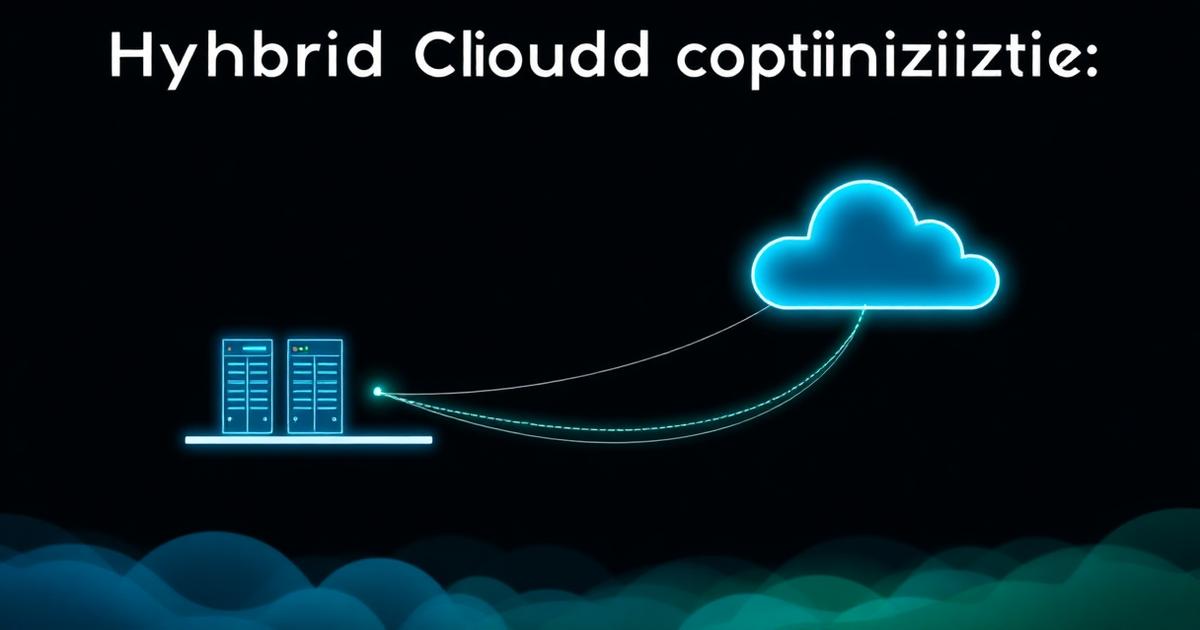
## The Hybrid Cloud Reality Check
Most enterprises didn't plan to have hybrid cloud — they ended up with it through a combination of cloud migration that hasn't fully landed yet, regulatory constraints that keep some workloads on-premises, and acquisitions that brought different cloud footprints together. The result is often a complex, expensive, inconsistently managed hybrid environment that costs significantly more than it should and delivers less than it could.
The 2026 reality is that hybrid cloud is permanent, not transitional. Even for organisations aggressively pursuing cloud-native strategies, there will always be some workloads that belong on-premises — because of latency requirements, data sovereignty, regulatory constraints, or simply because they perform better and cost less running on dedicated hardware they already own. The question isn't "how do we get to pure cloud?" but "how do we manage hybrid cloud well?"
## Workload Placement: The Foundation of Optimisation
The most impactful hybrid cloud optimisation decisions are about workload placement — which workloads belong where, and why. Most organisations make these decisions based on historical inertia ("it's always been on-prem") or fashion ("we're moving everything to cloud") rather than rigorous analysis.
The right framework for workload placement considers: total cost of ownership (cloud vs. on-premises, including the hidden costs of complexity and operational overhead), performance requirements (latency sensitivity, throughput needs, burst characteristics), regulatory and compliance constraints, data gravity (where your data lives and the cost of moving it), and operational complexity (some workloads are genuinely better managed in the cloud).
Cloud economics favour workloads with variable demand, bursty patterns, or temporary requirements. On-premises economics favour steady-state, predictable workloads where you can size hardware appropriately. The workloads that tend to produce the highest cloud bills relative to value are the ones that run at constant high utilisation 24/7 — these are often better candidates for reserved capacity or even on-premises infrastructure.
## Operational Consistency Across Hybrid Environments
The operational challenge of hybrid cloud isn't technology — it's consistency. Getting your infrastructure management, security policies, observability, and governance to work consistently across on-premises and cloud environments is where most organisations struggle.
Platform engineering for hybrid cloud typically means standardising on Kubernetes as the application runtime across environments (managing both on-premises and cloud clusters through a unified control plane like Rancher, Red Hat OpenShift, or Azure Arc), using Infrastructure as Code consistently across environments (same Terraform or Pulumi modules, parameterised for the target environment), and implementing unified observability across both environments (same monitoring tools, same alerting standards, same dashboards).
Azure Arc and AWS Outposts represent the cloud providers' approach to this challenge — extending cloud management planes to on-premises infrastructure. For organisations deeply committed to a single cloud provider, these can deliver significant operational simplification. For multi-cloud or provider-agnostic strategies, they introduce provider lock-in that needs to be weighed carefully.
## Network Architecture for Hybrid Cloud
Getting network connectivity right is fundamental and often underestimated. The network is the backbone of hybrid cloud, and poor network architecture creates bottlenecks, security risks, and unexpected costs that undermine all other optimisation efforts.
SD-WAN has become the standard for connecting branch offices and data centres to cloud environments in a flexible, cost-effective way. Modern SD-WAN solutions provide intelligent traffic routing that optimises path selection dynamically based on application requirements, available bandwidth, and cost. For multi-cloud environments, SD-WAN with built-in cloud connectivity to multiple providers is more cost-effective than direct dedicated circuits to each provider.
Egress costs are a significant and often overlooked component of hybrid cloud costs. Cloud providers charge for data leaving their networks but not for data entering. Workloads that generate large volumes of outbound traffic to on-premises systems or other cloud providers can accumulate surprising egress charges. Architecture decisions that minimise data movement between environments (co-locating computing with data where possible) can significantly reduce these costs.
*Lara IT Solutions provides hybrid cloud architecture design and optimisation for UK enterprises. Contact 0330 043 1930.*