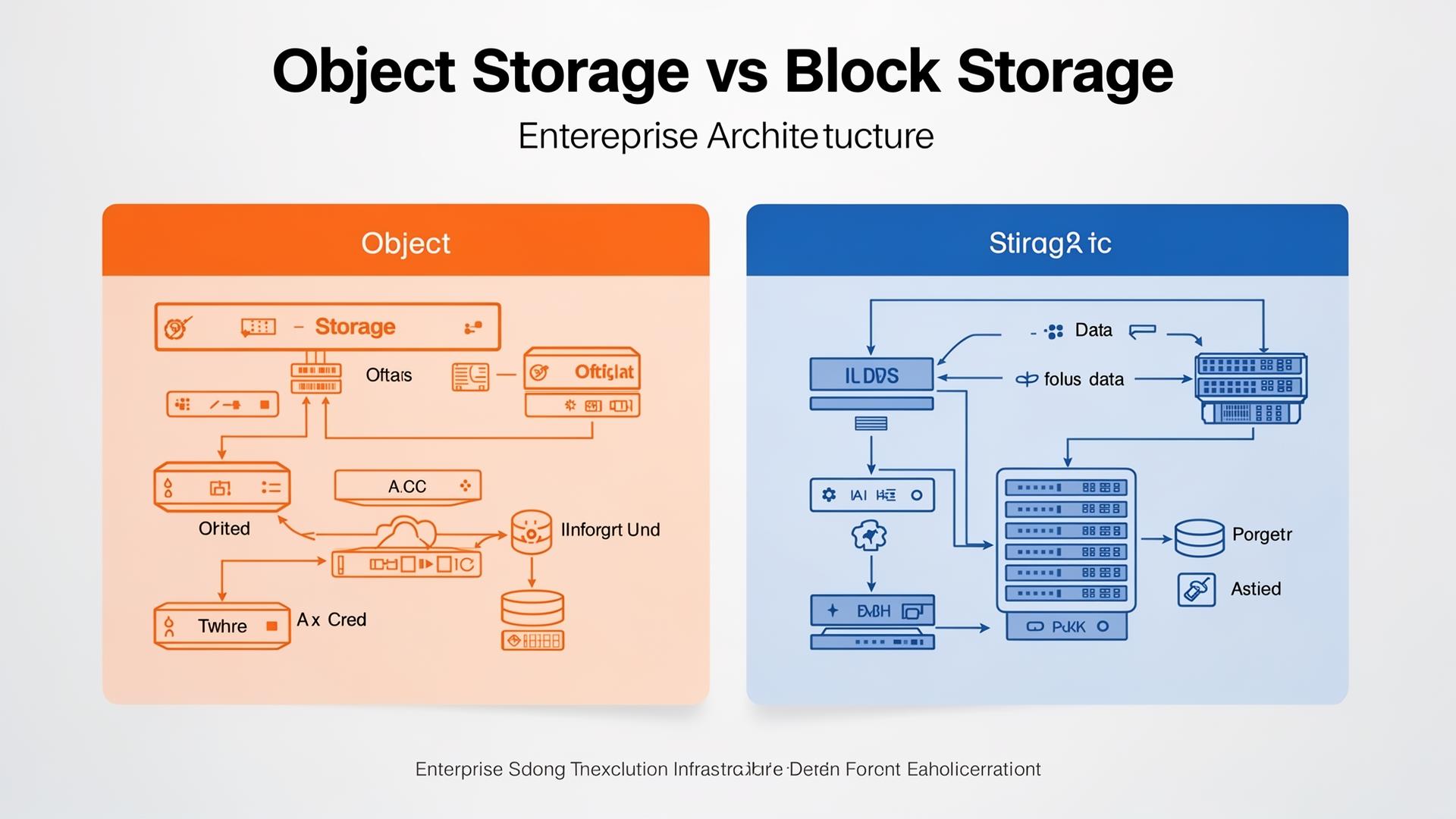
# Object Storage vs Block Storage: Choosing the Right Foundation for Your Data
Storage decisions shape application architecture. Choose wrongly and you build on a foundation that constrains rather than enables. Object storage and block storage represent fundamentally different approaches.
Understanding these differences enables appropriate placement. Some workloads clearly suit one or the other. Many benefit from using both in combination.
## Block Storage Fundamentals
Block storage presents raw storage volumes to connected systems. Think of it as virtual hard drives. The storage system manages blocks of data.
Operating systems treat block storage like local disks. Install operating systems on it. Format file systems. Store database files. Applications read and write data exactly as they would to local storage.
**Performance characteristics** suit demanding workloads. Low latency access. High IOPS for transactional workloads. Consistent performance for databases and virtual machines.
Block storage typically connects to single systems. A volume attaches to one server.
## Object Storage Fundamentals
Object storage abandons traditional file system concepts. Data exists as discrete objects identified by unique keys.
Access occurs through **APIs rather than file system protocols**. HTTP requests store, retrieve, and list objects.
**Scalability** differs fundamentally. Object storage scales horizontally across distributed systems. Petabytes and billions of objects pose no architectural challenge.
**Durability and availability** come built in. Objects replicate automatically across multiple locations.
**Cost structures** favour capacity over performance. Storing data cheaply across commodity hardware is the model.
## Comparing Characteristics
**Latency** favours block storage significantly. Operations complete in microseconds for high performance block. Object storage operates in milliseconds.
**Throughput** depends on workload patterns. Block storage excels at random access. Object storage efficiently handles large sequential transfers.
**Scalability** advantages go to object storage. Block storage clusters have practical limits. Object storage scales indefinitely.
## Use Case Alignment
**Databases** almost always require block storage. The random access patterns and low latency requirements align perfectly.
**Virtual machines** need block storage for boot volumes. The operating system expects disk like behaviour.
**Media assets** suit object storage excellently. Images, videos, and documents store efficiently. Web distribution works naturally.
**Backup and archive** leverage object storage cost efficiency. Large volumes of infrequently accessed data.
If you need guidance on storage architecture, contact us through our contact page.
## Architecture Patterns
Common patterns include:
- databases on block storage with snapshots,
- backups and archives on object storage,
- and analytics pipelines that land raw data in object storage.
## Cost and Lifecycle
Object storage is often cheaper at scale, but retrieval and egress can surprise you. Design lifecycle rules (hot → warm → archive) and budget for data movement.