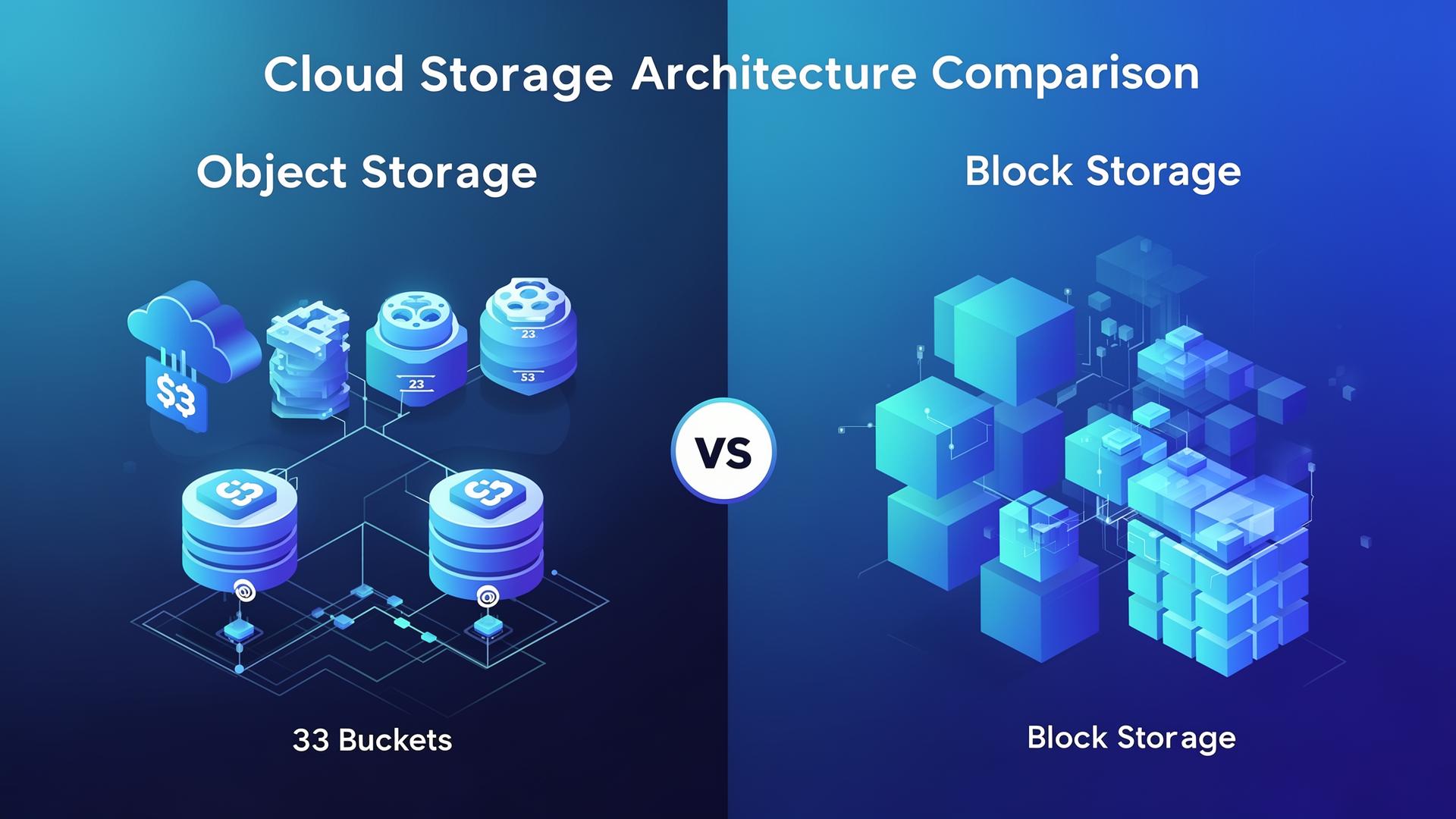
# Object Storage vs Block Storage: Choosing the Right Storage Architecture
Storage architecture decisions ripple through applications. The choice between object and block storage affects performance, scalability, cost, and operational complexity. Understanding the differences enables appropriate selection.
Block and object storage represent fundamentally different approaches. Each excels in specific scenarios. Neither is universally superior.
## Block Storage Explained
Block storage presents raw storage volumes to operating systems.
**LUNs and volumes** appear as local disks. Operating systems format them with filesystems. Applications see familiar disk semantics. Read and write at arbitrary byte offsets.
**Performance characteristics** favour low latency. Direct block access minimises overhead. IOPS and throughput matter. Databases and transactional applications thrive.
**Protocols** include iSCSI, Fibre Channel, and NVMe. SAN architecture connects storage arrays to hosts. Cloud block storage like EBS and Managed Disks abstract the physical layer.
**Limitations** emerge at scale. Filesystems have size limits. Metadata overhead grows. Block storage is harder to distribute globally.
## Object Storage Explained
Object storage uses a flat namespace of objects identified by keys.
**Objects** contain data plus metadata. Immutable by default—updates create new versions. Retrieved by key rather than file path.
**Scalability** exceeds block storage by design. Petabytes and billions of objects handled routinely. Global distribution built in. S3 and Azure Blob demonstrate scale.
**Access methods** differ from block. HTTP APIs rather than filesystem semantics. Eventually consistent in some implementations. Not directly mountable without adaptation.
**Cost efficiency** favours object storage. Tiered storage classes reduce expense. Lifecycle policies automate data movement. Ideal for archival and backup.
## Choosing Appropriately
Workload characteristics guide selection.
**Databases** need block storage. Random access patterns require low latency. Filesystem semantics expected. Block storage provides.
**Backup and archive** suit object storage. Large sequential writes. Infrequent access. Cost sensitivity. Object storage wins.
**Media and content** often prefer object storage. Large files. High throughput rather than low latency. CDN integration. Object storage fits.
**Application data** varies. Structured data in databases needs block. Unstructured content fits object. Evaluate specific requirements.
If your organisation needs help designing storage architecture or evaluating storage solutions, contact us through our contact page.
## A Simple Selection Rule
- Choose **block storage** when you need low-latency random I/O and filesystem semantics (databases, boot volumes).
- Choose **object storage** when you need massive scale, durability, and simple HTTP access (backups, archives, media).
## Security Considerations
Object storage breaches are often configuration mistakes. Enforce:
- private-by-default buckets,
- least-privilege IAM,
- and continuous posture scanning.
Enable versioning and immutability where available to support ransomware recovery.