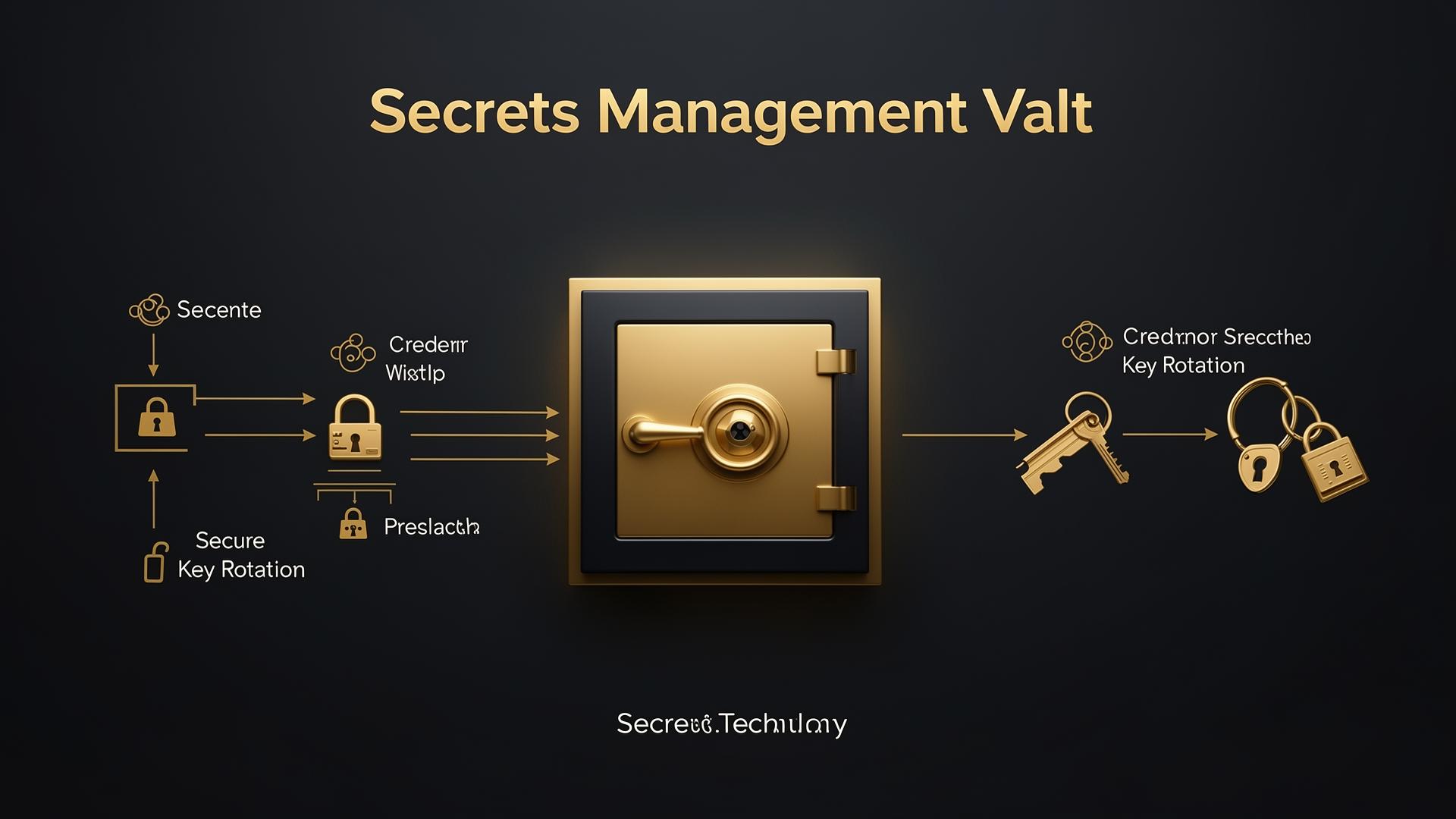
# Secrets Management: Keeping Credentials Safe in Automated Pipelines
Credentials scattered across code repositories, configuration files, and CI systems create security risks. Secrets management centralises and protects sensitive data while enabling automation.
## The Secrets Problem
Applications need credentials. Database passwords, API keys, encryption keys. These secrets enable access to sensitive resources.
**Hardcoded secrets** in code repositories create risk. Anyone with repository access sees credentials. Git history preserves them even after removal.
**Configuration files** on servers contain secrets. Anyone with server access can read them.
**CI/CD systems** need secrets for deployment. Pipeline configurations may expose them in logs.
## Secrets Management Platforms
**HashiCorp Vault** provides comprehensive secrets management. Centralised storage. Access controls. Audit logging.
**Cloud provider services** offer managed secrets. AWS Secrets Manager, Azure Key Vault, Google Secret Manager.
**Kubernetes secrets** provide basic capability. Better than environment variables but still require encryption at rest.
## Dynamic Secrets
Traditional secrets are static. Created once and used until rotated. Long-lived credentials create extended exposure windows.
**Dynamic secrets** are generated on demand with limited lifetimes. Database credentials created for each application instance. Automatically expired after use.
## Integration Patterns
**Application SDK integration** retrieves secrets at runtime. Applications call secrets management APIs.
**Sidecar injection** provides secrets to applications. A separate container retrieves secrets and makes them available.
**CI/CD integration** provides secrets during deployment. Pipeline tools retrieve secrets for deployment configuration.
If your organisation needs help implementing secrets management, contact us through our contact page.
## The Baseline: What Good Looks Like
Modern secrets management is not just a vault. It is a lifecycle:
- **Create** secrets in a controlled system (not in someone’s terminal history).
- **Distribute** with least privilege to workloads (short-lived credentials where possible).
- **Rotate** on a schedule and on suspected compromise.
- **Revoke** instantly when staff leave or systems are rebuilt.
- **Audit** access and changes.
## Common Enterprise Pitfalls
**Environment variable sprawl**: secrets end up in CI logs, crash dumps, and screenshots. Mitigate with masked logs, restricted debug, and secret scanning.
**Shared service accounts**: convenient but dangerous. Prefer per-service identities and scoped permissions.
**Static long-lived keys**: rotate towards federation (OIDC, workload identity) or just-in-time tokens.
## Practical Implementation Tips
- Separate **human access** (break-glass) from **machine access** (workloads).
- Make rotation a **non-event**: design apps to reload credentials without downtime.
- Use a **secret naming standard** so teams can find the right credential quickly.